
Over the past few weeks, Instagram has quietly begun testing a string of new features.
On their own, they're incremental product updates.
Taken together, they paint a very clear picture of where the platform is heading.
And if you're a founder, marketing manager or CMO using Instagram to build awareness, they should influence how you think about content over the next 12 months.
Here's what we're seeing.
Instagram is reportedly testing the removal of public follower counts, replacing them with mutual connections instead.
Rather than seeing someone has 250,000 followers, visitors may simply see which of their own contacts already follow that account.
If this rolls out widely, one of social media's biggest status signals disappears.
That's a positive development for businesses.
For years we've seen companies obsess over audience size.
But buyers rarely choose suppliers because they have the biggest following.
They choose the people who consistently demonstrate expertise.
If follower counts disappear, your content, profile and positioning have to do the convincing.
The brands with genuine authority will benefit.
Those relying on vanity metrics won't.
Instagram is also testing an account-level "AI Creator" label for accounts regularly publishing AI-generated content.
This isn't about punishing people who use AI to speed up workflows.
Almost every marketing team does that now.
It's about transparency.
As AI-generated content becomes easier to produce, originality becomes more valuable.
The people sharing first-hand experience, unique opinions and genuine expertise will become easier to separate from those simply prompting ChatGPT.
For B2B brands, that's an opportunity.
Your competitive advantage has never been producing the most content.
It's producing content your competitors can't.
Meta is also testing paid episodic content through a feature currently referred to as "Short Drama."
At first glance, it looks designed for entertainment creators.
But the wider message is more interesting.
Instagram appears to be rewarding creators who can keep audiences coming back.
Not just people capable of producing one viral Reel.
Instead, think:
Again, I feel this is very much a sign of the big shift back to 'vlog culture' with content online. People are craving that real, raw look at what people's lives/businesses are like.
One of the most practical updates is also one of the simplest.
Instagram is rolling out a built-in teleprompter inside Reels.
You can now display a scrolling script directly beneath the camera while recording.
For founders who've avoided video because they struggle remembering scripts, this removes one of the biggest barriers.
Better eye contact.
Less editing.
Faster production.
I for one, am over the moon about this update!
Meta has confirmed that Instagram Edits is coming to desktop.
That may not sound exciting, but for brands producing content at scale, desktop editing means faster workflows, more precise edits, better colour correction and much easier collaboration.
The line between mobile creator tools and professional editing software continues to blur.
Expect production quality across Instagram to keep rising.
Instagram is also testing a redesign that gives Reels even greater prominence.
Now, none of this is particularly surprising. Instagram has been moving this direction for years.
So if you're still treating video as optional, you're gradually reducing the amount of platform real estate available to your business.
Instagram is also testing screenshot prevention for certain Stories.
The aim is straightforward.
Allow creators, businesses and communities to share more exclusive content without worrying about screenshots being distributed elsewhere.
For brands running VIP communities, subscriber content or customer-only updates, this could become genuinely useful.
Private content becomes more valuable when it stays private.
Strip away the individual features and the direction becomes obvious.
Instagram is rewarding:
None of this means you need to overhaul your strategy tomorrow.
But it does reinforce where smart brands should already be investing:
And remember that Instagram increasingly wants creators who keep audiences returning week after week, not just scrolling for another 15 seconds.
The platform is changing, but the fundamentals aren't.
Useful content, delivered consistently by people worth listening to, is becoming more valuable, not less.
If you found this useful, subscribe to The Social Advantage™.
Every issue breaks down the platform changes, algorithm updates and shifts in buyer behaviour that matter to founders, marketing leaders and in-house teams.
At Social Advantage™, we help businesses build personal brands, company brands and social media strategies that generate awareness, authority and commercial results.
Work with us here.
Most businesses are still approaching LinkedIn the wrong way.
They focus on posting more.
More content. More frequency. More noise.
But that’s not what drives results.
Recently, our founder Jack joined Claire Marshall on the Brand Mixology podcast to unpack how LinkedIn is actually evolving, and why the businesses seeing real ROI are playing a completely different game.
Here are the key insights from that conversation.
Most people obsess over what they’re posting.
Very few think about what happens after someone clicks their profile.
In reality, your LinkedIn profile is your digital storefront. It’s where decisions are made.
And now, there’s a second layer to consider: AI.
Tools like ChatGPT and Claude are increasingly surfacing people based on how well their profiles are structured, written, and positioned. If your profile isn’t built with both humans and machines in mind, you’re limiting your visibility before the conversation even starts.
A strong profile doesn’t just describe what you do. It positions you clearly, builds trust quickly, and makes it obvious who you help and how.
One of the biggest misconceptions is that LinkedIn is a content platform.
It isn’t.
Content supports visibility. But relationships drive revenue.
The businesses winning on LinkedIn are the ones treating it as a 24/7 networking environment, not a broadcast channel.
That means:
If your entire strategy begins and ends with posting, you’re missing the majority of the opportunity.
A simple but powerful shift:
If you wouldn’t grow your business that way in real life, don’t do it online.
Think about how you win business offline:
LinkedIn should reflect exactly that.
Instead of chasing trends or copying what others are doing, the most effective approach is to replicate your real-world business development process, just at scale.
LinkedIn is no longer just a marketing channel.
It’s a business development tool.
When used properly, it allows you to:
But it only works if you move beyond surface-level activity.
Jack’s full conversation with Claire Marshall on the Brand Mixology podcast dives deeper into these ideas, with practical examples and strategies you can apply immediately.
🎧 Listen here: https://lnkd.in/e-q9-5AB
And if your LinkedIn profile isn’t working as hard as it should be, download our free guide to optimising your positioning for both AI search and human engagement:
The businesses that win on LinkedIn over the next few years won’t be the loudest.
They’ll be the clearest, the most strategic, and the most consistent.
That’s the shift.
Welcome to the latest edition of The Social Advantage™, your monthly lowdown on what’s changing across the social platforms, and how to stay one step ahead.
As we head into 2026, I'm seeing clear patterns emerge across social platforms, search, and AI-driven discovery:
As you look ahead to 2026, it's so important to take note of these changes to social, because on a strategic level, they affect everything.
Gone are the days of "post more - get more" on nearly all of the platforms.
Social media today is about being relevant and discoverable for the right people, and then providing enough value to them that they feel inspired to save or share your content.
Social Search (or Social SEO - the practice of optimising your social content and profiles for better discovery on social media platforms, much like you would do to optimise your website for it to be found on Google) combined with GEO (optimising your content/website for it to be found by AI LLMs like ChatGPT) should be at the centre of your strategy, no matter the type of brand that you work for/run/lead.
In this issue, I'm delving into some of the recent updates, stories and topics that further reinforce this.
Let’s take a look.

Generative Engine Optimisation (GEO) is quickly becoming the new benchmark for digital visibility as we head into 2026.
As consumers increasingly turn more to AI chatbots, agentic workflows and answer engines to find information, appearing in AI-generated responses will matter more than ranking first in traditional search results.
Discovery is shifting from keywords to context, and from websites to ecosystems.
Michael King, founder of iPullRank, describes this shift as the SEO industry being “pulled reluctantly into the GEO era.” While there’s still overlap between SEO and GEO today, that overlap won’t last forever.

His team has moved towards a framework called “relevance engineering”; a blend of AI, content strategy, UX, information retrieval and digital PR designed to influence what AI engines choose to surface.
And this is where social comes in. AI answer engines increasingly pull from social platforms, creator content, Reddit threads, short-form video, and online communities.
Social content is no longer just marketing output, it is becoming training data.
Why it matters: Visibility is moving away from where you rank and towards whether you’re referenced. If your brand, people, or ideas aren’t present in the places AI pulls from, you’re effectively invisible.
Takeaway for B2B Founders & Marketers: Start thinking signal-first, not channel-first. Create content that answers real questions, travels across platforms, and earns citations, not just clicks.
Source: LinkedIn News Europe

Reddit has officially overtaken TikTok to become the fourth most-visited platform in Britain.
That’s a clear signal about how people are choosing to discover and validate information.
Search algorithms increasingly prioritise solution-led content, and Reddit’s integration into AI-generated answers has massively accelerated its visibility.
We spent much of 2025 talking about social search, but this is the strongest confirmation yet that it’s no longer a “nice to have.”
People aren’t just scrolling for entertainment. They’re searching for answers.
They're looking to learn from lived experiences and get recommendations (and proof).
And Reddit is where much of that trust-building happens.
Why it matters: Discovery isn’t about one platform winning over another. It’s about behaviour. Audiences are moving fluidly between search engines, social platforms, forums and AI tools to form opinions and make decisions.
Takeaway for B2B Founders & Marketers: Treat Reddit like a search platform, not a social channel. Use it to understand pain points, objections, language and emotional drivers, then feed that insight into your creative, messaging and positioning. If you’re not visible in those conversations, someone else is shaping the narrative for you.
Source: Andie Bain

For a long time, social search felt like something users did instinctively, while platforms quietly ignored it.
That’s changing. TikTok introduced search reporting. Instagram has now followed. Google Search Console now reports on the search performance of social content.
Instagram has even started recognising search as a source of views.
This is the platforms acknowledging what users have been doing for years: using social to discover brands, validate decisions and answer questions.
Why it matters: Discovery is no longer linear.
People bounce between Google, TikTok, Instagram, Reddit and LinkedIn in a single journey. Platforms are now measuring that reality, and rewarding content that fits naturally into it.
Takeaway for B2B Founders & Marketers: Your 2026 content strategy needs to work across intent states.
Create content that performs in-feed but also surfaces in search, with clear context, strong hooks and genuine usefulness.
Source: Carrie Rose
This is more of a shoutout to a recent post from Pretty Little Marketer , that I thought summed up the 'disconnect' between people's understanding of social media platforms' algorithms and how they actually operate. In this post, they mention that:
Algorithms aren't secret forces working against you... they're 'matching' systems.
They explain how these systems work differently for existing followers compared to the people who've never seen you before. See the diagram below for a further visual explanation:
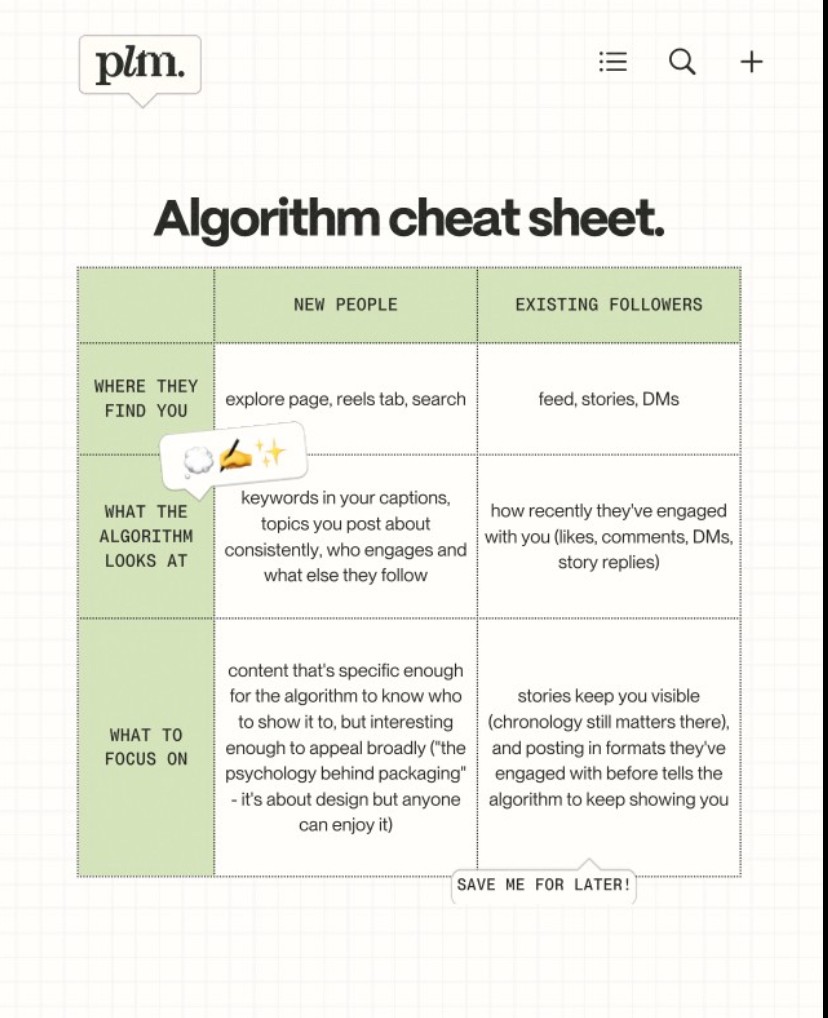
The bottom left one is so important for discovery now. It's no longer about posting 6x times a day, because if all 6 of those posts aren't 'findable' by the people that matter to your brand, it's a waste of effort.
Why it matters: The rules have changed. Starting with this fundamental understanding of the algorithms BEFORE you craft a social media strategy for your brand is crucial for success.
Takeaway for B2B Founders & Marketers: In 2026, focus less on 'doing more' and more on how you will get new and existing people to find you.
Source: Pretty Little Marketer
Instagram has officially limited hashtags to five per post.
This aligns with years of messaging from Instagram chief Adam Mosseri, who has repeatedly stated that hashtags no longer meaningfully drive reach. AI-driven recommendation systems now do most of the heavy lifting when it comes to discovery.
Hashtags still have a role, but it’s a supporting one.
They help label content, not propel it.
Why it matters: The algorithm now relies far more on visual recognition, caption semantics and user behaviour than on hashtag volume. Over-stuffing captions with generic tags can now actively work against you.
Takeaway for B2B Founders & Marketers: Use fewer, more relevant hashtags and focus your energy on clarity, structure and relevance. That’s what feeds both AI discovery and human understanding.
Source: Social Media Today

The brands that will win in 2026 will think beyond just 'showing up'. They will optimise for social search and AI/GEO as well as algorithms, and create content that’s discoverable, worth saving, sharing and citing, not just liking.
Sure, it’s more work. But it’s also far more defensible.
If any of this has you rethinking your 2026 social strategy, and you want a second opinion, or would like to discuss having a strategic partner on board to create and enact a social media strategy for your brand, let's chat.
Book a call with me by clicking the link below:
http://bookacallwithjacklongman.com
See you next month 👋
– Jack
Every month, I publish a newsletter on the latest changes, trends and updates on Social Media. This ranges from platform updates, trending content formats, to industry news and more.
This month, I’m doing it a little differently, as there is so much happening with socials most versatile platform, Instagram, at present, I felt it deserved it’s own issue.
Below are 4 big changes happening on Instagram at present, alongside point number 5 which gives you a general overview of what see working on the platform right now.
Let’s get into it.

Because the algorithm and user behaviour have both moved on.
👉 Algorithm shift: Instagram no longer prioritises posts purely based on hashtags.
👉 User search behaviour: People are now using Instagram’s search bar like Google — looking for topics, products, and answers, not just tags.
👉 Keyword integration: The platform can “read” your content using keywords in captions, bios, and even video scripts.
So while hashtags still have a place for categorisation and niche discovery, they’re not the lever they once were.
For years, the playbook was “use all 30 hashtags in the copy” and hope for people to discover you through them. Today, thanks to the ‘interest based’ algorithm that many social platforms have adopted in response to the rise of TikTok, reach is driven by relevance and content quality.
Treat Instagram like a search engine. Don’t worry about hashtags unless it’s a specific event or categorisation/branding thing.
Optimise your captions and creative for discoverability and engagement.
Follow the guide above and you’ll likely see a rise in performance.

Instagram is phasing out ‘View Rate’ and replacing it with Skip Rate, which shows how many people scrolled past your Reel within the first three seconds.
This shift puts even more pressure on the opening hook.
If your skip rate is high, you’ve lost people before they even gave it a chance.
If it’s low, your hook worked.
This shows clearly that Instagram wants creators to focus on attention, not just exposure.
Those first few seconds now carry even more weight in both content strategy and performance metrics.
DEDICATE TIME AND ENERGY to the first three seconds of each piece of content so that it can be the best it can be.
Whether it's by using a bold title, a strong visual or an unexpected hook, the goal should be to make your intros impossible to scroll past.
Instagram now supports 1080 × 1440 px posts, which is slightly taller than the previous 1080 × 1350 standard. That gives you more vertical real estate in the feed.
More space on the screen = More potential eyeballs. Keep to 1350x1080 inside your bigger design to remain on the safe side!keep to 1350x1080 inside your bigger design to remain on the safe side!
But in your grid, those posts still display cropped at 1350 px.
And many scheduling tools haven’t caught up yet.
See our graphic below for guidance!

This isn’t a huge design shift, but it’s another reminder that Instagram is optimising for the scroll. Taller posts stand out more, but you need to plan your design to keep key content within the safe zone.
For now, stick to 1080 × 1350 px if you’re batching or scheduling posts. If you’re posting manually and want to test the taller format, just make sure your key info doesn’t get cut off on the grid.
A quiet but seemingly important update as all social platforms become a part of ‘search’ strategies around the globe. Verified Instagram profiles now appear at the top of search results.

That means more visibility and potentially more followers for those paying for the badge.
There’s a growing list of new tools and tweaks across the platform:
Meta Verified is no longer just a badge. It's becoming a fast track to visibility and access. Instagram continues to quietly reshape the creator toolkit with small updates that add up to a much more personalised, searchable experience.
If visibility and search are a priority for your brand (Tip: IT ABSOLUTELY SHOULD BE), Meta Verified might be worth a test.
And keep an eye on Instagram’s feature set. Even small updates like inbox filters or editing tools can shift how people engage with your content.
Instagram’s current algorithm favours content that’s useful, valuable and easy to reshare or save.
Instagram is doubling down on intent-based engagement.
Saves, shares, retention and SEO-friendly writing are now just as important as traditional likes and comments, if not more.
Build content that answers real questions or solves small problems. Layer in keywords naturally, keep your Reels snappy and treat carousels like mini-guides people will want to keep.

As always, if you’d like to talk through how these changes could impact your Instagram strategy or content planning, just comment below or send me a DM. I’m always up for a chat.
If you got value from this, or feel it would help someone you know, it would mean the world to me if you could like, comment and repost it to your network.
And don’t forget to subscribe if you haven’t already! As I mentioned previously, I post this newsletter every week on the latest updates, trends, insights and changes happening on social media.
See you in the next one. 👋 – Jack
Welcome to the August edition of The Social Advantage™, your monthly dose of what’s shifting across the social platforms, and what it means for the way we create, promote, and measure content.
This month, we’re seeing platforms double down on clarity, control, and (in some cases) personal taste.
LinkedIn has finally dialled back the chaotic flood of old posts, while also quietly confirming that hashtags aren’t pulling much weight anymore.
Facebook's ad system is rewarding shorter videos with more replays, giving us another reason to keep it snappy.
Threads, Meta’s X rival, is quietly gaining ground (especially on mobile) while Instagram experiments with smarter carousel insights, and X continues its war on emojis (yes, really).
The themes are platform power plays, audience behaviour shifts, and some subtle but important changes that could affect your next campaign or post.
Let’s get into it.

LinkedIn has also clarified its stance on hashtags, and the verdict is… they’re not that important anymore.
While you can still use them, LinkedIn’s AI and keyword detection models now do most of the heavy lifting when it comes to understanding post content.
Hashtag-based feeds are being phased out entirely.
Why it matters: This is the clearest signal yet that LinkedIn is prioritising context and clarity over symbols.
The algorithm is smart enough to read and categorise your content without needing the # symbol, which means posts stuffed with hashtags aren’t just redundant, they might even look a bit outdated or spammy.
Takeaway for marketing managers and CMOs: Focus on writing clear, keyword-rich copy that mirrors how your audience actually searches and talks about problems. Treat your captions like mini-SEO: weave in industry terms, client challenges, and solution language naturally. Hashtags can be used sparingly for organisation, but the real optimisation now lies in how well your content speaks for itself.Source: SocialMediaToday


Meta has confirmed a small but interesting detail about Facebook video ads: if your ad is under 30 seconds long, it’ll automatically loop for up to 90 seconds.
That means shorter videos could play 3–6 times in a row, depending on length, giving your message more chances to land.
For example, a 15-second ad might loop 6 times in a row.
Meta says it dynamically adjusts looping time (between 90–180 seconds) depending on what’s likely to drive the best results.
Why it matters: We live in a world where attention spans are shrinking, so shorter ads already tend to perform better, and now, they might get more exposure too.
While viewers can always scroll past, if someone stays, your brand message could play multiple times within a short window.
Takeaway for marketing managers and CMOs: Test short, punchy video ads under 30 seconds.
They’re not just cheaper to produce, they may earn more plays, brand recall, and overall impact thanks to Facebook’s looping behaviour.
Source: SocialMediaToday

New data from SimilarWeb shows that Threads, Meta’s rival to X (formerly Twitter), is rapidly closing the gap in mobile daily active users. In the US, Threads now has around 16 million mobile DAUs, up from 8 million last year, while X sits at 23 million.
On iOS devices alone, the gap is even narrower: 13.1 million for Threads vs 15.3 million for X. Web traffic still heavily favours X, but if Threads keeps leveraging its ties to Instagram and Facebook, mobile could be its way in.
Why it matters: Threads was written off by many after its buzzy launch faded, but clearly, it’s gaining momentum. While X still leads overall, particularly for news and trending topics, Threads’ steady growth suggests Meta isn’t done building its alternative to the bird app.
Takeaway for marketing managers and CMOs: If you abandoned Threads after the hype died down, it might be worth a second look, especially for mobile-first audiences.
The platform’s connection to Instagram makes it a natural fit for brand discovery and community building.
Source: Forbes

Following June’s ban on hashtags in promoted posts, X is now turning its attention to emojis.
Advertisers using more than one emoji in their ad copy or creative may now face higher ad costs and lower “quality scores,” according to new guidance.
Why the change?
...It’s not clear, but it follows a pattern of Elon Musk’s personal taste shaping the platform’s design and ad rules.
Elsewhere on X, new AI-powered age verification tools are being rolled out in response to EU and UK regulations.
These include government ID checks, selfie scanning, and email verification to restrict access to sensitive content for underage users.
Oh, and Musk says he’s bringing back Vine “in AI form.”
No further details yet lol.
Why it matters: Ad rules on X are shifting fast, and often without warning.
Between hashtags, emojis, and creative format quirks, the cost and performance of your ads could change overnight.
Takeaway for marketing managers and CMOs: If you’re advertising on X, keep your creative clean and minimal to avoid surprise penalties.
And stay tuned; platform volatility means your strategy may need frequent adjustments.
Source: PR Daily

IIn the 5 years that we’ve been in business, we’ve never seen the social media landscape so volatile.
The only constant is change, and so we strive to keep out ahead of all of the changes as much as we can, in order for us to provide the best services and create the most effective content possible for our clients.
In the next issue, we’re going to be doing a deep dive on the latest changes on Instagram.
Basically, there have been too many to feature in a section of this newsletter; they need their own issue!
If you've got a question about anything in this instalment, get in touch!
Until next time 👋
– Team Social Advantage™
Welcome to the July edition of The Social Advantage™, your monthly shortcut to the biggest shifts in social, and what they mean for your content, ads, and reporting.
This time, we’re covering:
👉 Why Instagram Reels might deserve a longer reporting window
👉 LinkedIn’s new video-powered newsletters
👉 TikTok testing broadcast messaging (Bulletin Boards)
👉 And X banning hashtags from promoted posts (yes, really)
There’s a lot changing in how people discover and engage with content. Let’s dig in.

Fresh data from Measure Studio shows a surprising pattern:
That’s a huge difference, and it means if you’re reporting on Reels performance after a standard 30-day cycle, you could be missing a significant chunk of their true impact. It challenges the old “monthly metrics” mindset, suggesting Reels need a much longer tail for meaningful measurement and evaluation.
Why it matters: Short-form video isn’t just a short-term play now. This slower burn could influence how you plan campaigns, set expectations, and communicate performance to stakeholders. A Reel might appear to underperform in the first month, only to surge in reach and engagement over the next month or two.
🧠 Takeaway for B2B founders & marketers: Adjust your measurement windows. Consider tracking Reels for at least 60–90 days, especially if you’re using them to build brand awareness, drive organic reach, or test creative concepts. Reels are a long game, not just a quick hit.
Source: Measure Studio / Andy Lambert

We’re noticing another “long tail” trend on LinkedIn: older posts resurfacing in people’s feeds days or even weeks after they were published. That’s great news for evergreen content; posts with long shelf lives can keep driving profile views, engagement, and inbound leads far beyond their initial burst of reach.
But it’s not all upside. If you’re sharing time-sensitive content, like an event with a firm deadline or a campaign with limited slots, older posts showing up later could create confusion or send people to outdated links.
Why it matters: LinkedIn’s feed is increasingly prioritising relevance and engagement signals over recency. While that can work in your favour for authority-building posts, it means you’ll need to stay vigilant with anything time-limited.
🧠 Takeaway for B2B founders & marketers: Embrace the long tail for evergreen posts, but for time-sensitive content, consider adding “in date” signals in your copy (for example, “this event runs until 30 July”) to avoid confusion if it resurfaces weeks later. And keep monitoring engagement on older posts to ensure the right message is reaching the right people.

LinkedIn has confirmed it’s rolling out video options for newsletter and article headers. That means your cover image can now be a short, engaging video, which will autoplay in-feed and show up as a thumbnail in subscriber emails.
Why it matters: Video is hot on LinkedIn right now. It’s seeing 36% growth year-on-year, and is 20x more likely to be shared than other formats. Adding video covers could boost engagement with your newsletters and help you stand out in a crowded feed.
LinkedIn recommends:
🧠 Takeaway for B2B founders & marketers: If you already run a LinkedIn newsletter (or want to start), test video headers ASAP. They’re rolling out globally, so now’s a good time to experiment.
Source: Social Media Today

TikTok is following Instagram’s lead on Broadcast Channels with a feature called Bulletin Boards. It lets creators and brands share one-to-many DM-style messages with their followers, including text, images, and video; up to 20 bulletins a day.
Fans can react, but they can’t reply, giving brands more control while keeping the conversation focused.
Why it matters: More users are spending time in DMs and private chats, and TikTok doesn’t want to miss out on that. Bulletin Boards could help brands push exclusives, sneak peeks, or promos straight to superfans.
🧠 Takeaway for B2B founders & marketers: If you get access, think of Bulletin Boards as another community-building tool. The first movers will probably see the strongest results.
Source: Social Media Today / Techcrunch

In classic Elon style, X (formerly Twitter) has decided to ban hashtags in promoted posts, arguing they’re an “esthetic nightmare” that distract from the ad’s message.
Why it matters: While hashtags can help with organic discovery, in a paid setting they can draw clicks away from your intended call-to-action, sending people off to explore the hashtag instead of clicking on your website or offer. That’s why even before this rule, X’s ad teams had long advised advertisers to limit or remove hashtags from ads.
Still, a total ban is a pretty bold step. It means advertisers can no longer promote branded hashtags or campaign tie-ins within paid posts, which could affect campaigns that rely on user-generated content or hashtag challenges. This is very much an “Elon decision” in style, prioritising aesthetic over broader strategic flexibility.
🧠 Takeaway for B2B founders & marketers: If you’re running ads on X, update your creative. Hashtags are now a no-go. It might help focus clicks, but could limit reach for hashtag-driven campaigns.
Source: Social Media Today
As you can see, platforms are shifting how they reward, display, and measure content, from long-tail Reels to newsletter video headers to the rise of DM-style channels.
If you’d like to talk through how these changes could affect your reporting, paid campaigns, or content plans, just hit reply or drop us a DM.
See you next month 👋
– Team Social Advantage™
Last week, we had the pleasure of bringing together clients, suppliers, introducers, and friends of Social Advantage™ to mark a major milestone: our five-year anniversary.

Held at The Editor’s Tap in Fetter Lane, London, the event was a moment to pause, reflect and celebrate everything the team and our community have achieved together.
The evening was filled with great conversation, smiles, selfies, fantastic food and drinks — a true testament to the relationships we’ve built over the last half-decade.
Our founder, Jack Longman, took to the floor with a heartfelt and humorous speech, thanking our clients for trusting us with their brands, our suppliers, introducers and partners for their ongoing trust and support.
Jack also gave a special shoutout to the Social Advantage™ team, whose creativity, passion, and hard work are at the heart of everything we do.
Guests were able to network, catch up, and enjoy the evening, with plenty of stories shared from over the years.
The atmosphere was buzzing with optimism for what’s ahead, as we look to build on the momentum of these first five years and continue growing with our clients.
We’re proud to say that Social Advantage™ has gone from Jack cold-calling at the kitchen table to becoming a trusted partner of global brands for B2B social media management, content creation, and brand building, and none of that would have been possible without the incredible community that surrounds us.
To everyone who came along to raise a glass, thank you.
And to those who couldn’t make it, we missed you, but hope to celebrate with you soon.
Scroll down to see some highlights from the event, and here’s to the next five years!

Welcome to the latest edition of The Social Advantage™ – your monthly lowdown on what’s changing across the social platforms, and how to stay one step ahead.
This time, we’re diving into:
👉 Meta’s leaked data (spoiler: followers aren’t the flex they used to be)
👉 Google’s AI Mode indexing your TikToks, Shorts, and Reddit threads
👉 TikTok’s legal limbo – and who stands to gain
👉 A powerful new LinkedIn insight most people are sleeping on
👉 A retiring LinkedIn feature that could impact profile traffic
👉 And TikTok’s new AI assistant for sellers
There’s a lot shifting under the surface, but don’t worry, we’ve done the digging so you don’t have to.
Let’s get into it.

Google just launched AI Mode, and it’s changing how people discover brands.
Search is no longer about matching keywords. It’s now about mirroring the user: their habits, routines, and moods. Google’s new AI-powered results are built from a hyper-personalised profile, and increasingly, that includes what users are seeing on TikTok, YouTube Shorts, Reddit, Pinterest, and beyond.
Yep, short-form video and shared content are being indexed directly into the AI-generated search results. And in many cases, Reddit threads, YouTube comments and TikTok Reels are the source Google is quoting.
Why it matters: The lines between social and search are officially blurred. Google is pulling semantic and contextual cues from what people say online, not just what brands publish. That means your creator partnerships, social posts, PR mentions, and forum visibility are now search signals.
🧠 Takeaway for B2B Founders & Marketers: You’re not just posting for engagement anymore – you’re training the algorithm. Seeding content on TikTok, Reddit, YouTube Shorts, and Pinterest can now boost your discoverability in Google AI results. Borrow credibility from trusted voices, optimise creator content for real-world questions, and don’t ignore “non-search” platforms. Google isn’t.
Source: Google

LinkedIn has rolled out two small but mighty insights that could shift how we measure content success on the platform:
That second one is a bit of a big deal. Because while likes and comments are nice, profile views often signal genuine interest – the kind that leads to conversations, connections, and new business.
Why it matters: These metrics give you a better look at the quiet impact of your posts, especially the ones that might not “go viral” but still move people to take action behind the scenes. If you’re creating content to build authority, generate leads, or open doors, this is the signal to watch.
🧠 Takeaway for B2B Founders & Marketers: Start tracking profile views alongside engagement metrics. Reframe success around who took a closer look, not just who clicked “like.” And if you’re getting views but no outreach, it might be time to tighten up that headline and profile CTA.
Source: Andy Lambert

Leaked internal documents from Meta have revealed some fascinating shifts in how content is discovered and shared – and it’s not great news if you’re still chasing followers and likes.
Here’s what stood out:
In other words, the classic model of public engagement is being replaced by private sharing. Likes and comments aren’t disappearing, but they’re no longer the most important signals. Instead, success now depends on how shareable, savable, and snackable your content is.
Why it matters: Social media is starting to look more like messaging platforms than public forums. Content that gets passed around privately – in DMs, chat groups, or even saved for later – is what’s driving reach. And that means measuring success is about to get a lot trickier.
🧠 Takeaway for B2B Founders & Marketers: Focus less on follower count, more on creating content that travels. Think value-packed Reels, carousel frameworks, surprising stats, relatable humour, and quotes that demand to be shared. The algorithm is watching what people save and send, not just what they like.
Source: Andy Lambert, Meta Court Filings

Earlier this year, TikTok briefly disappeared from US app stores following the “divest-or-ban” law targeting ByteDance. The platform was taken offline on January 19th, but quickly returned — although it remained missing from the App Store and Google Play for several weeks.
A presidential executive order later paused enforcement for 75 days, and TikTok’s listings were finally restored in mid-February. But here’s the thing: the threat of a full ban hasn’t gone away — and the US government’s deadline is still looming.
During the blackout, Meta platforms saw a spike in content consumption, especially on Reels. If a permanent ban ever lands, it’s clear who’s poised to absorb TikTok’s creators, viewers and ad budgets.
Why it matters: TikTok has become one of the biggest discovery engines on the internet. If it disappears from the US (or other key markets), the social content landscape will shift hard — fast. Brands that rely heavily on TikTok virality or ecommerce will need contingency plans. And the platforms waiting in the wings? Meta, YouTube Shorts, and even Pinterest.
🧠 Takeaway for B2B Founders & Marketers: If TikTok is part of your content or ad strategy, start thinking about platform diversification. Reels, Shorts and Pinterest are well-positioned to catch the spillover. And if a ban never comes? You’ve built resilience. Either way, don’t put all your discovery eggs in one algorithmic basket.
Sources: Andy Lambert, The Verge
TikTok is leaning even harder into e-commerce, with a new AI chatbot baked into its Seller Center platform.
The new Seller Assistant helps creators:
TikTok says it’s “not just a chatbot”…but it definitely is. Still, it could be a game-changer for small brands and creators trying to navigate TikTok Shop with limited time or expertise.
Why it matters: TikTok ecommerce is growing fast. Live-stream sales are booming, and video-to-purchase behaviour is becoming more natural on the platform. A tool like this could remove some of the friction and empower more creators to sell with confidence.
🧠 Takeaway for B2B Founders & Marketers: If your brand (or your clients) are dabbling in TikTok ecommerce, this tool could help streamline content and drive better results, especially for product-led businesses. Even if you’re not selling yet, the trend is worth watching. The line between entertainment and shopping keeps blurring.
Source: Social Media Today

If you’ve added a clickable call-to-action link to your LinkedIn profile using a Premium account, don’t touch it. LinkedIn is retiring the feature.
You’ll no longer be able to:
If you already have one in place, it’ll stay visible – but that’s it. And no explanation has been given, beyond LinkedIn’s usual “we’re always evolving our features” line.
Why it matters: This was one of the few ways creators and freelancers could drive direct traffic from LinkedIn to their external content or offer. Now, it’s another quiet shift towards keeping users on the platform, and likely tightening control on questionable links that could affect SEO or ad trust.
🎯 Takeaway for B2B Founders & Marketers: If you rely on LinkedIn to drive conversions, you’ll need to get creative with your links – especially in comments, featured sections, and document posts. For businesses, Premium Company Pages still get prominent CTA buttons, so company-led traffic-driving isn’t dead. But personal brand CTAs just got harder. | Source: Social Media Today
That’s it for this month’s edition of The Social Advantage™.
As you can see, discovery is changing. Whether it’s AI-driven search, private shares, or short-form video turning up in SERPs – the rules are shifting fast. But the brands that adapt early are the ones that’ll win.
Got a question, content dilemma, or something keeping you up at night? Hit reply or drop us a DM – we’re always happy to chat.
See you next month 👋
– Team Social Advantage™


